
Mortar is not merely a gap-filler in traditional stone construction. It is an integral structural component that binds stones together, seals the wall against water penetration, and distributes load evenly across irregular stone faces. In Canada, where winter temperatures regularly drive masonry below freezing, the choice of mortar type, mix ratio, and joint profile has a direct effect on how long a stone structure remains intact.
The Role of Mortar in Stone Masonry
In a mortared stone wall, each joint serves three functions simultaneously. It bears load from the courses above, it resists lateral forces that could cause stones to shift, and it limits water ingress. A mortar that is too hard — stronger than the stone it binds — will transfer the stresses of thermal movement and frost heave directly into the stone face rather than accommodating them through joint compression. The result is spalling: the progressive surface damage that strips the face off individual stones.
Traditional masonry across Canada and the British building tradition it largely inherited operated on the principle that mortar should be the sacrificial element in the system. If something must erode, crack, or be repaired, it should be the joint — not the stone. This is why historic stone structures built with lime mortars often show deep-weathered but intact stone surfaces while their original joints need periodic renewal.
Lime Mortars vs. Portland Cement Mortars
Until the late 19th century, virtually all stone masonry in Canada used natural hydraulic lime or non-hydraulic putty lime as the primary binder. These mortars set slowly, remain slightly flexible after curing, and are permeable enough to allow moisture to migrate through the joint and evaporate from the surface. They are also softer than most building stone, meaning they yield before the stone does under stress.
Portland cement, introduced into widespread Canadian construction in the early 20th century, is harder, faster-setting, and less permeable. In new construction with modern stone or concrete masonry units, it performs well. In historic stone structures, it is problematic. Portland cement mortar creates a nearly impermeable joint that traps moisture within the wall cavity. When that moisture freezes, it has nowhere to go except into the stone itself — contributing to the spalling and cracking that is now common in pre-1920 stone buildings where Portland-based repointing has been applied.
Guidance from Ontario Heritage Trust and Parks Canada's Historic Places Initiative consistently recommends lime-based mortars for repointing work on pre-1920 stone structures. The general principle is that repointing mortar should be no stronger — and ideally slightly softer — than the original material.
Mortar Mix Ratios
The ratio of binder to aggregate determines mortar strength and flexibility. For traditional work and historic repointing, the following mixes are commonly referenced in Canadian heritage masonry practice:
- 1:2.5 to 1:3 NHL 2 or NHL 3.5 (natural hydraulic lime) to sharp sand: Suitable for sheltered interior or semi-interior stonework. Relatively soft and highly flexible.
- 1:2 to 1:2.5 NHL 3.5 to sharp sand: General-purpose mix for exterior stone walls in most Canadian climates. Balances flexibility with adequate weather resistance.
- 1:2 NHL 5 to sharp sand: For exposed or highly loaded applications where hydraulic set strength is required. Harder than the two ratios above; suitable for foundations and heavily loaded piers, but should not be used for general repointing of softer stones.
Sand quality matters significantly. Angular sharp sand produces a stronger matrix than rounded beach sand. River sand is generally acceptable; manufactured sands from aggregate suppliers are consistent and widely available across Canada.
Joint Profiles
The profile of a mortar joint — its cross-sectional shape at the wall face — affects both weather resistance and appearance. Several profiles are used in Canadian stone masonry:
- Flush joint: Mortar is struck level with the stone face. Common in interior work. Not recommended for exterior masonry in wet or cold climates, as the exposed joint face collects water rather than shedding it.
- Recessed (raked) joint: Mortar is raked back 6 to 10 mm behind the stone face. Emphasizes the stone texture visually. In exposed Canadian locations, recessed joints collect ice and are prone to faster erosion; they are generally avoided in heritage conservation practice.
- Weather-struck joint: The top edge of the joint is pushed back slightly and the lower edge projects, creating a small ledge that sheds water downward. Good weather resistance for vertical joints.
- Bucket-handle (rodded) joint: The joint face is concavely profiled with a rounded tool. Sheds water reasonably well and is one of the most common profiles in historic Ontario and Quebec stonework. Visually the most neutral and least likely to look anachronistic when used in repairs.
When repointing a historic structure, matching the original joint profile is both aesthetically appropriate and structurally sound. Original profiles were often chosen with local weather conditions in mind by masons who knew the site.
Repointing Procedure
Repointing requires removing deteriorated mortar to a depth of at least 20 mm — roughly two to three times the joint width — before applying new material. Shallow repointing, where new mortar is applied directly over existing eroded joints without proper excavation, bonds poorly and fails quickly. The new mortar has too little bearing surface and too little depth to resist moisture cycling and freeze-thaw pressure.
Joint raking can be done with hand tools such as cold chisels and raking irons, or with angle grinder-mounted raking bits for large projects. When using power tools on historic stone, care must be taken not to damage the stone arises — the sharp edges where the stone face meets the joint. Once damaged, these edges cannot be restored.
After raking, the joint cavity should be dampened with clean water before applying new mortar. Dry masonry pulls moisture out of fresh mortar too quickly, preventing proper curing. In hot, dry summer conditions — common in Canadian Prairie cities — covering freshly pointed work with damp burlap for 24 to 48 hours helps maintain adequate moisture for curing.
New mortar should be applied in layers no thicker than 10 to 15 mm per pass. Deep joints require multiple applications, with each layer partially cured before the next is placed. Attempting to fill a deep joint in one pass results in shrinkage cracking and poor adhesion at depth.
Trowel Tools and Working Methods
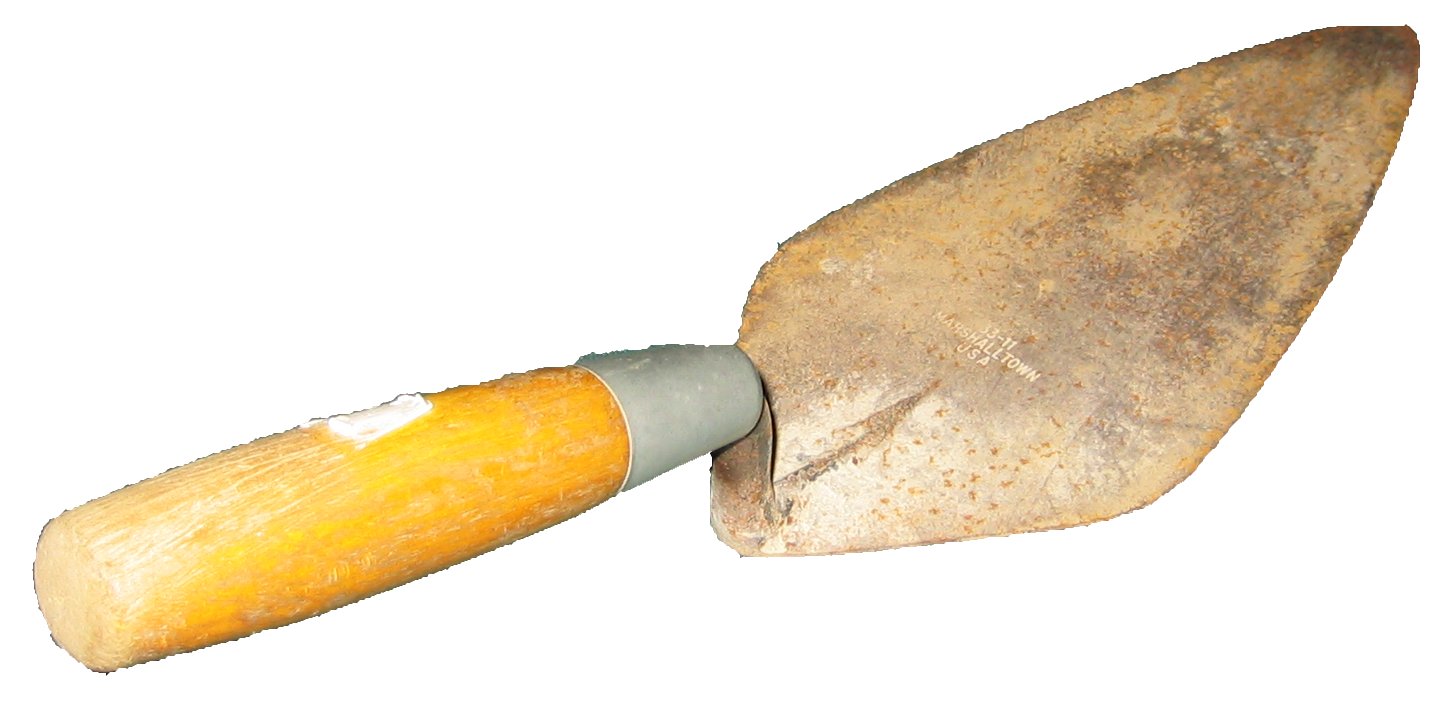
For pointing work, a pointing trowel — narrower and more flexible than a standard brick trowel — is used to pack mortar into raked joints. The joint is filled from the bottom upward, pressing mortar firmly against the back face to ensure contact. A jointing iron or round rod is then drawn along the joint to form the desired profile before the mortar reaches full hardness.
Working in cold weather requires special precautions. Fresh lime mortar should not be exposed to temperatures below 5°C until it has cured for at least 48 hours. In Canadian autumn and winter conditions, temporary enclosures and supplemental heating are standard practice for masonry work on heritage structures. Frost protection during initial cure is not optional — a single overnight freeze can destroy several days of pointing work.
Reading Joint Condition
Before repointing, it is useful to probe existing joints to understand the extent of deterioration. A pointed tool — a screwdriver or awl — drawn across the joint face will reveal whether the mortar is sound or has softened and lost cohesion beneath an apparently intact surface crust. Soft joints that crumble under light pressure need repointing. Joints that are simply shallow from surface erosion but still cohesive at depth may only need a wash and inspection.
Pay attention to horizontal joints at water shedding points — window sills, projecting string courses, and copings. These see concentrated water flow and typically deteriorate faster than other joints. They are also the most structurally significant: a failed joint below a coping stone allows water directly into the wall core, where it can go undetected for years.
Also on Stone Corner House
Stone foundations and the specific masonry challenges of below-grade work in Canadian climates are covered separately.
Stone Foundations in Canada